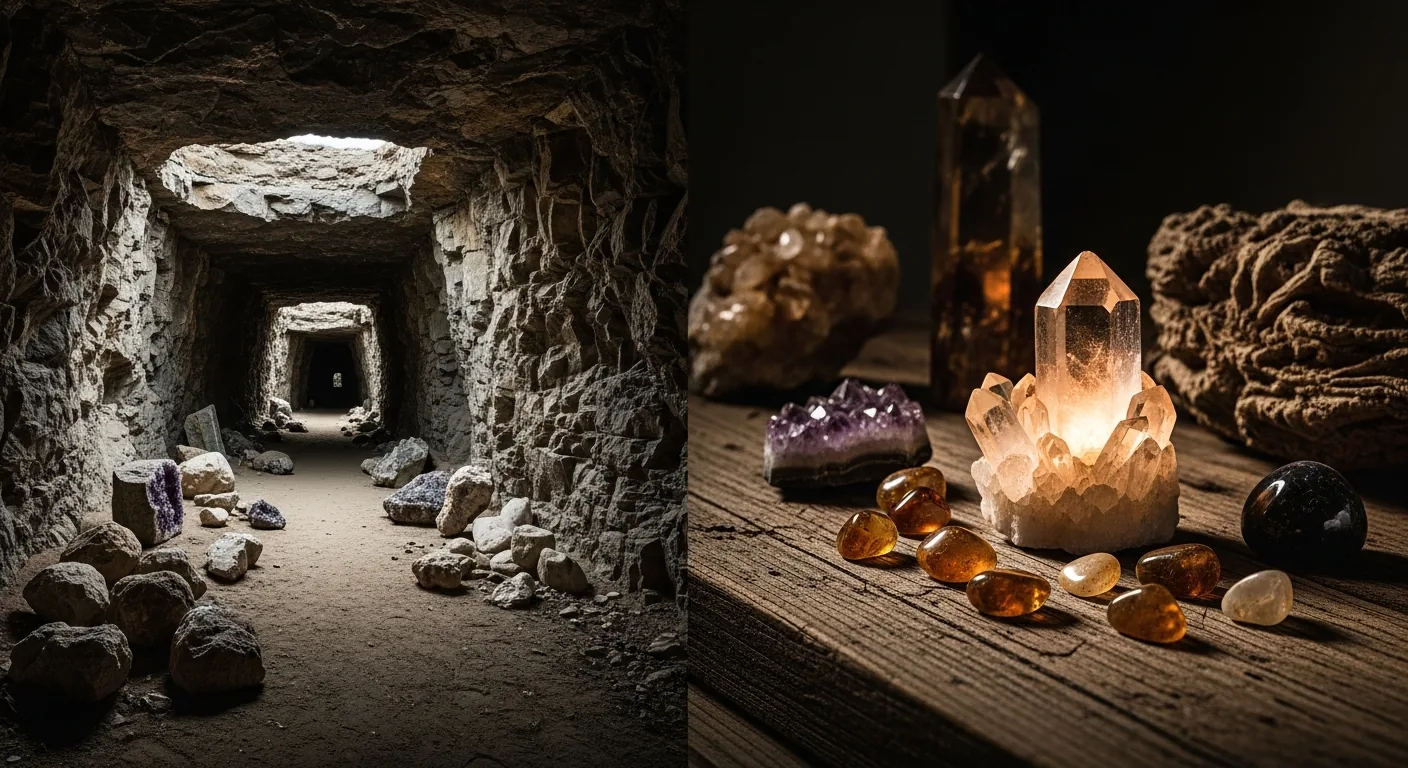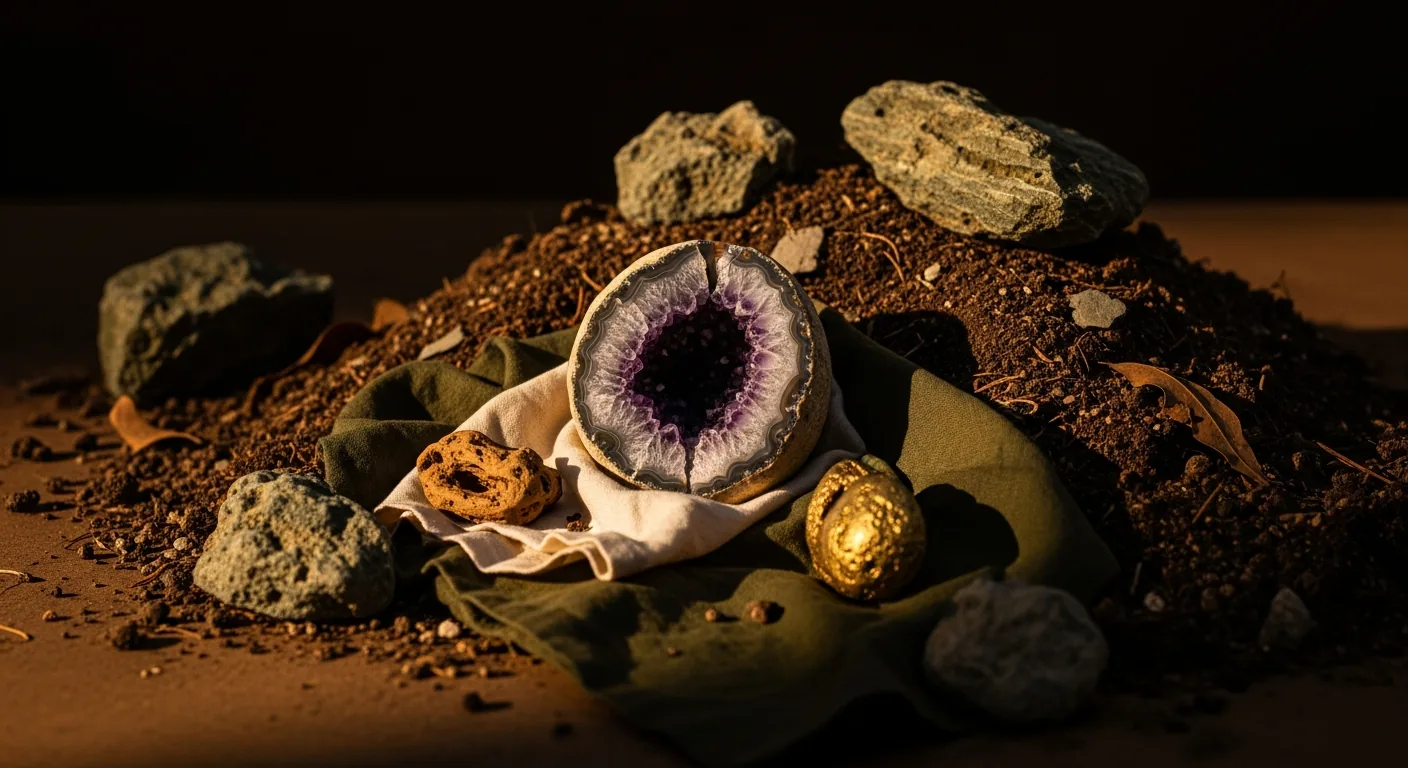
When we started VeraLuna, we had a simple conviction: the crystals we sell should be stones we would want to own ourselves. That meant knowing where they come from, how they were extracted, and whether the people involved in bringing them to market were treated fairly. This page is our attempt to share that journey honestly — what we do well, what we are still working on, and why transparency matters more than perfection.
Our Sourcing Philosophy
We believe every crystal carries the energy of its entire journey — from the earth it formed in, to the hands that extracted it, to the care taken in preparing it for you. That belief shapes every sourcing decision we make. We prioritise direct relationships with small-scale miners and trusted wholesalers, favour regions with established mining traditions and fair labour practices, and choose quality over quantity at every stage.
We are a small European business, not a multinational. Our supply chain is measured in dozens of suppliers, not thousands. That scale is actually our advantage — it means we can know our partners personally, visit key sources, and make decisions based on relationships rather than spreadsheets.
Our sourcing is not perfect. No crystal supply chain is. But we commit to being honest about what we know, what we do not know, and what we are doing to close the gaps.
How We Select Our Suppliers: 5 Criteria
Every supplier we work with is evaluated against five criteria. Not every partner scores perfectly on all five, but meeting at least three is our minimum threshold, and we work with suppliers to improve the others over time.
1. Traceability
We want to know where every crystal was mined — at minimum the country, ideally the region or specific mine. Suppliers who can trace their stones back to named mining communities earn our strongest trust. We ask every new supplier to walk us through their supply chain, identifying each intermediary between the mine and our warehouse.
Some crystals are easier to trace than others. Large specimens, geodes, and raw clusters often have clear provenance because they travel through fewer hands. Small tumbled stones, which are typically processed in bulk, are harder to trace to a specific mine but can usually be traced to a region.
2. Working Conditions
We ask direct questions about miner safety, fair wages, and child labour policies. For our closest supplier relationships, we have firsthand knowledge from visits and ongoing communication. For others, we rely on supplier certifications, reputation within the industry, and information shared by fellow European retailers who source from the same regions.
We favour suppliers who work with artisanal and small-scale mining communities where extraction is done with hand tools and local knowledge. These operations tend to have lower safety risks than tunnel mining and provide sustainable livelihoods for families who have worked the land for generations.
3. Environmental Responsibility
We prefer crystals from low-impact mining methods. Small-scale surface mining and hand excavation create minimal disruption compared to industrial open-pit operations. When we source from larger operations, we look for evidence of site rehabilitation, water management, and waste reduction.
Packaging is part of the environmental equation too. We have moved to recycled and recyclable packaging materials, minimised plastic in our shipping process, and consolidated shipments to reduce transport emissions.
4. Quality and Authenticity
Every crystal we sell is genuine. We do not sell synthetic stones marketed as natural, and we clearly label any treatments (heat treatment, coating, stabilisation). When a crystal has been enhanced — for example, most commercial citrine is heat-treated amethyst — we say so in the product description.
Our quality inspection process (described below) ensures that what arrives in your hands matches what you see on screen. No photographic tricks, no misleading colour enhancement in images, no exaggerated size descriptions.
5. Relationship Longevity
We invest in long-term partnerships over one-time transactions. Working with the same suppliers year after year allows us to build trust, verify claims over time, and gradually improve practices together. A supplier who was transparent about their limitations when we started working together three years ago has usually made real improvements by now — and we have been part of that conversation.
Our Quality Inspection Process
Every crystal that enters our inventory goes through a multi-step quality check before it reaches the shop.
Visual Inspection
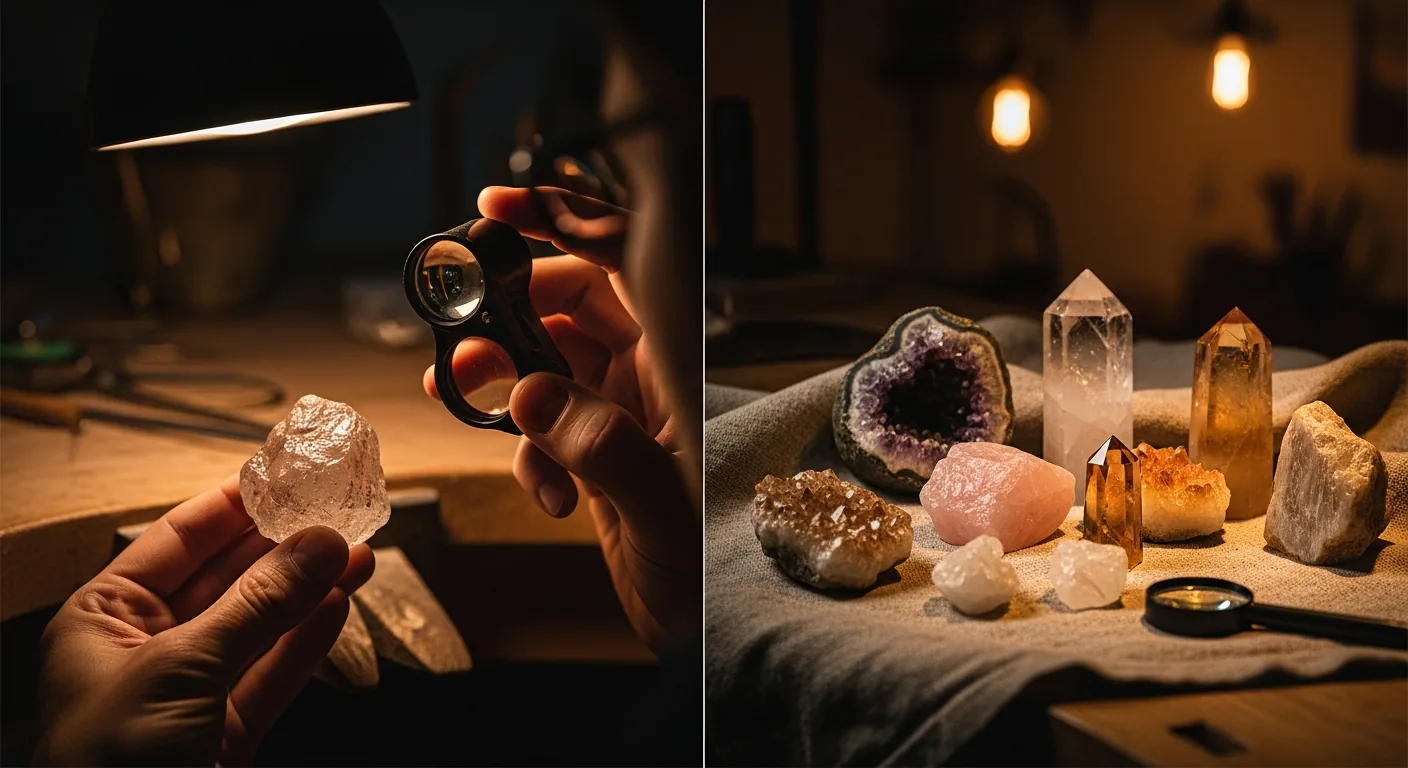
We examine each stone for damage, consistency with the listed mineral type, and overall aesthetic quality. Chips, fractures, or inconsistencies with the expected appearance are flagged. Stones that do not meet our visual standard are either returned to the supplier or directed to our tumbled stone processing.
Identification Verification
We verify that each crystal is what it claims to be. This matters more than most buyers realise — mislabelling is common in the crystal market. Dyed howlite sold as turquoise, glass sold as obsidian, reconstituted material sold as natural. We use mineral hardness testing, visual comparison with verified reference specimens, and specific gravity checks for higher-value stones.
Photography
We photograph our crystals under consistent, natural lighting conditions. What you see on the product page is what you receive. We do not artificially saturate colours or use filters that misrepresent the stone's true appearance. Variation between individual stones is expected and noted in our listings.
Storage and Handling
Crystals are stored in a clean, dry environment with appropriate separation (soft stones like selenite away from harder minerals that could scratch them). Each stone is wrapped individually for shipping, with protective packaging chosen based on the stone's hardness and fragility.
Where Our Crystals Come From
We source from multiple regions, each chosen for the quality of its minerals and the reliability of its supply chains.
Brazil
Our largest source for amethyst, clear quartz, rose quartz, and citrine. Brazil's Minas Gerais and Rio Grande do Sul regions have established mining traditions dating back centuries. We work with small-scale operations that extract crystals from geode deposits using a combination of hand tools and light machinery. Brazilian mining operates under federal environmental legislation (IBAMA) that requires environmental impact assessments and site restoration plans.
Madagascar
An important source for labradorite, rose quartz, moonstone, and various jaspers. Madagascar's crystal mining is predominantly artisanal — family and community operations using hand tools. The supply chain here is longer (more intermediaries), which makes traceability more challenging. We are working to shorten our Madagascar chain by developing relationships closer to the mining communities.
India
We source select stones — particularly moonstone, garnet, and certain agate varieties — from Indian suppliers. India has a long gemstone cutting and processing tradition, with major centres in Jaipur and Cambay. Our Indian partners operate formal workshops with documented labour practices.
Morocco
Our primary source for selenite and some desert rose formations. Moroccan selenite comes from well-known deposits in the Saharan regions, extracted through small-scale operations. The selenite trade supports local communities in areas with limited alternative employment.
European Sources
Where possible, we source from within Europe. Alpine quartz from Austria and Switzerland, amber from the Baltic region, and select minerals from deposits in Spain and Portugal. European sources offer the highest transparency and shortest supply chains, though the variety of available crystals is more limited.
Every crystal in our collection passes these standards. Take our quiz to discover which of our carefully sourced stones align with your energy.
Our Commitment to Transparency
Transparency means telling the full story, including the parts that are not perfect.
What We Know
For approximately 70% of our inventory, we can identify the country and region of origin with confidence. For our closest supplier relationships, we have visited the source or have detailed photographic and written documentation of mining conditions.
What We Are Still Learning
For the remaining 30%, typically small tumbled stones and certain specialty minerals, traceability ends at the wholesale level. We know the country of origin but cannot trace to a specific mine. We are actively working to improve this by reducing the number of intermediaries in our supply chain and asking more detailed questions of existing suppliers.
What We Will Not Do
We will not make claims we cannot support. If we do not know exactly where a crystal was mined, we will say so. If a stone has been treated, we will disclose it. If a supplier falls below our standards, we will end the relationship rather than compromise our integrity.
What We Are Working to Improve
Honest sourcing is a journey, not a destination. Here is what we are actively developing:
- Shorter supply chains: We are working to establish more direct relationships with mining communities, reducing intermediaries and increasing the share of the retail price that reaches miners
- Better documentation: We are building a system to track each crystal's journey from source to sale, starting with our highest-volume stones
- Packaging reduction: We have eliminated most plastic from our packaging and are testing fully compostable alternatives for protective wrapping
- Community support: We are exploring partnerships with organisations that support artisanal mining communities through education, safety training, and market access
- Carbon footprint: We are calculating the transport emissions associated with our supply chain and evaluating offset and reduction options
Frequently Asked Questions
How do I know your crystals are real?
Every crystal we sell undergoes identification verification before listing. We test hardness, examine structure, and compare against verified mineral references. We never sell synthetic material as natural, and we disclose all treatments (heat treatment, stabilisation, coating) in the product description. If you ever have doubts about a stone you received, contact us and we will verify it.
Do you visit your suppliers?
We visit our primary suppliers regularly and have established personal relationships with key partners in Brazil and within Europe. For suppliers in other regions, we rely on a combination of industry reputation, documentation, referrals from trusted partners, and increasingly, video calls that show us current conditions. We are expanding our direct visit programme as the business grows.
Why don't you only source from Europe?
European mineral deposits are limited in variety. Many beloved crystals — amethyst geodes, labradorite, lapis lazuli, moonstone — simply do not occur in European geology. Restricting ourselves to European sources would mean offering a fraction of the crystals our customers seek. Instead, we source globally but prioritise transparency and responsible practices regardless of region.
Are your prices higher because of ethical sourcing?
Responsible sourcing does add cost — shorter supply chains, quality inspection, fair pricing to suppliers, and sustainable packaging all have price implications. However, we work hard to keep our prices accessible. We absorb some of the additional cost as part of doing business the way we believe it should be done. Our prices are competitive within the European crystal market, and we believe the quality and integrity behind each stone justifies the value.
Can I request the origin of a specific crystal I purchased?
Yes. Contact us with your order number and we will share everything we know about the stone's origin, including country, region, and supplier details where available. If a stone falls into our less-traceable inventory, we will tell you that honestly rather than fabricating a story. We would rather give you an incomplete truth than a complete fiction.