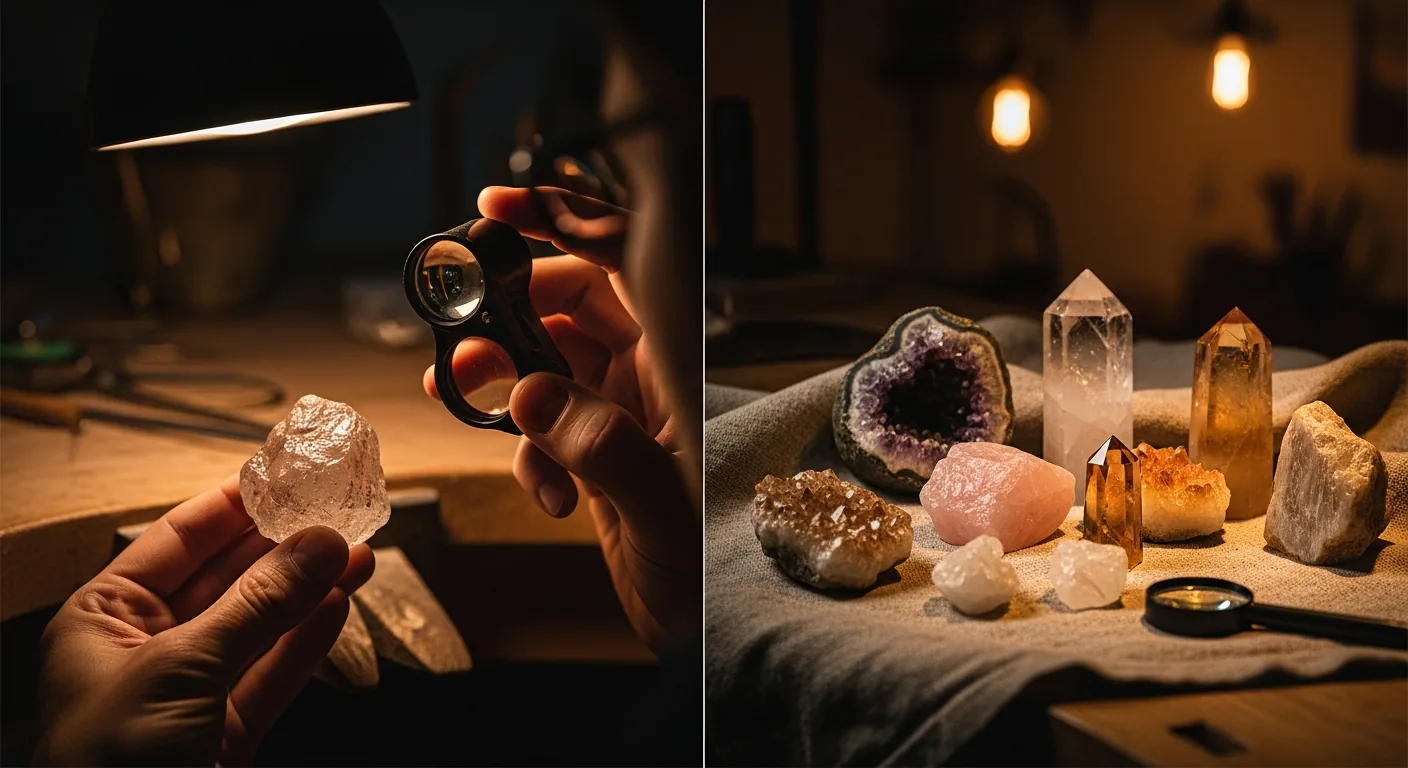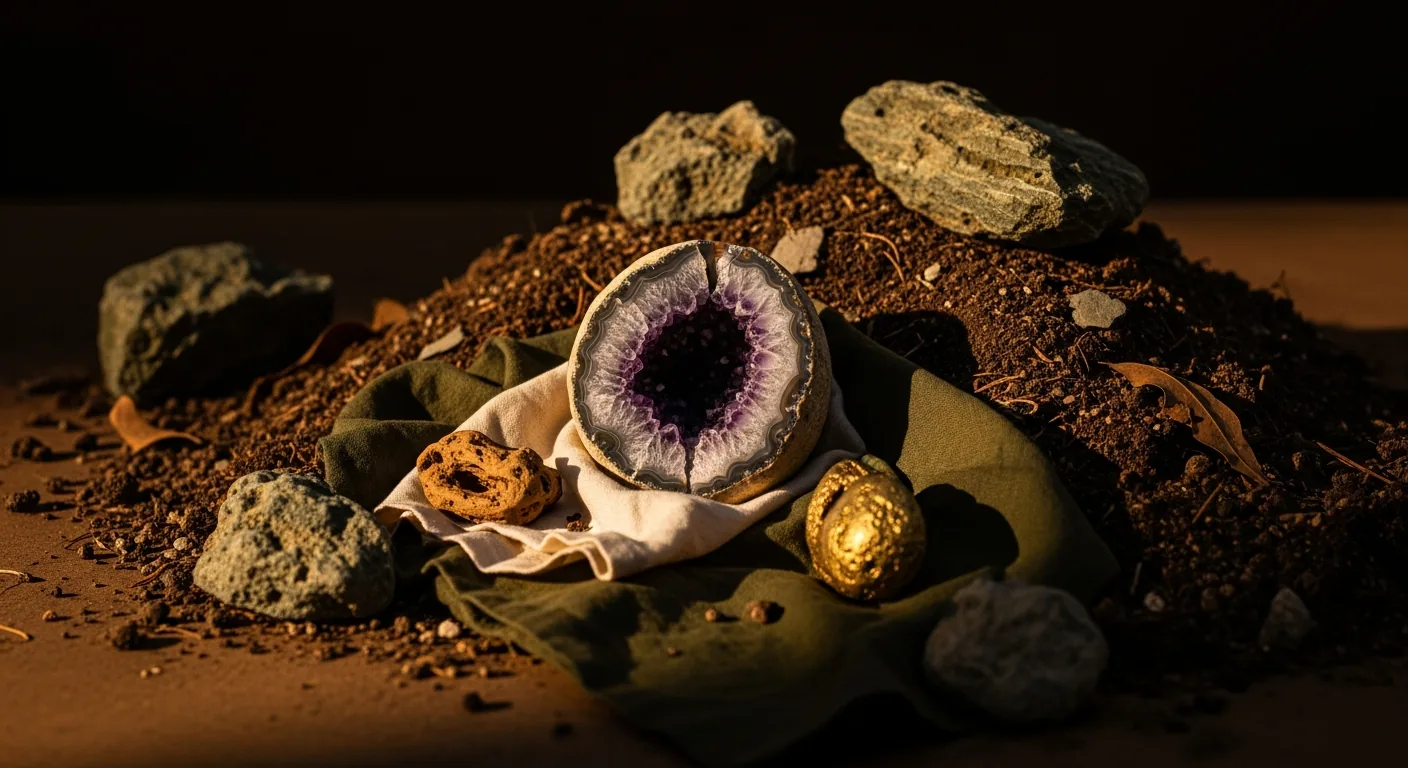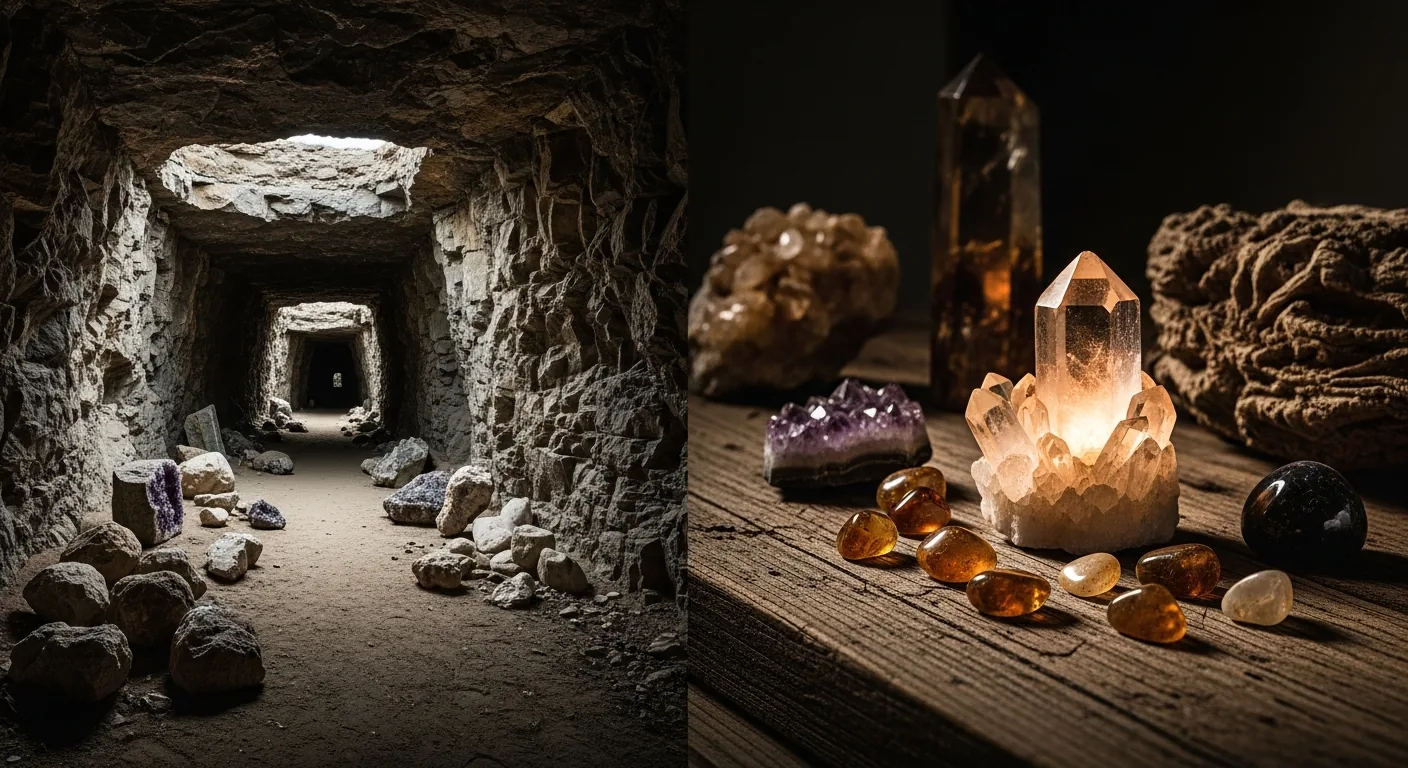
Every crystal you hold started as a geological process deep inside the Earth — pressure, heat, dissolved minerals, and time measured in millions of years. Understanding how crystals move from rock face to your shelf deepens your connection to them and helps you make informed choices about where your stones come from. This guide covers the full journey: formation, extraction, processing, and the path to market.
How Do Crystals Form in Nature?
Crystals form when dissolved minerals in superheated water or magma cool slowly enough for atoms to arrange themselves into repeating geometric patterns. This process can take anywhere from thousands to hundreds of millions of years, depending on temperature, pressure, and the minerals involved. Quartz crystallises from silica-rich solutions in rock cavities. Amethyst gets its purple from iron impurities and natural radiation. Each crystal's colour, clarity, and shape are direct records of its formation conditions.
The three main geological processes that create crystals are:
- Igneous formation: Minerals crystallise as magma or lava cools. Slow cooling deep underground produces large, well-formed crystals (granite contains quartz, feldspar, and mica). Rapid cooling near the surface produces smaller crystals or volcanic glass like obsidian
- Sedimentary formation: Mineral-rich water evaporates or deposits layers over time. Selenite, halite (rock salt), and some agates form this way. These crystals often grow in flat, layered environments
- Metamorphic formation: Existing rocks are transformed by extreme heat and pressure without melting. Garnet, lapis lazuli, and certain varieties of jade form under these conditions. The mineral rearrangement creates new crystalline structures within the host rock
Types of Crystal Mining
Artisanal Mining
Artisanal mining is the oldest and most widespread method of crystal extraction. Individual miners or small groups use hand tools — picks, shovels, chisels, and pry bars — to extract crystals from surface deposits, shallow pits, or small tunnels.
Where it happens: Madagascar, parts of Brazil, Pakistan, Afghanistan, India, and much of sub-Saharan Africa.
What it looks like: Small open pits or narrow tunnels following a mineral vein. Miners identify promising rock by colour, texture, and experience passed down through generations. Extraction is slow and selective — individual crystals or clusters are carefully freed from surrounding rock to preserve their form.
Crystals commonly extracted this way: Amethyst (from geodes), tourmaline, aquamarine, moonstone, labradorite, lapis lazuli, and many varieties of quartz.
Advantages: Low environmental footprint per stone, supports rural livelihoods, preserves crystal quality through careful hand extraction.
Challenges: Safety risks (unstable tunnels, no protective equipment), inconsistent income for miners, limited access to global markets without intermediaries.
Small-Scale Mining
Small-scale mining bridges the gap between hand-tool artisanal work and industrial operations. These mines use some mechanised equipment — small excavators, generators for lighting, basic ventilation in tunnels, and motorised rock-cutting tools.
Where it happens: Brazil (Minas Gerais is a major hub), Uruguay, Namibia, Zambia, and parts of China.
What it looks like: Organised operations with defined mine boundaries, some infrastructure (access roads, sorting areas), and a small permanent workforce. Production is steady but not industrial-scale.
Crystals commonly extracted this way: Large amethyst cathedrals, citrine, rose quartz in bulk, smoky quartz, and fluorite.
Advantages: Better safety conditions than artisanal mining, more consistent supply, some regulatory oversight in many jurisdictions.
Challenges: Higher environmental impact than hand mining, still limited transparency in many supply chains.
Large-Scale Industrial Mining
Industrial crystal mining involves heavy machinery, engineered pit designs, and significant capital investment. These operations extract hundreds or thousands of tonnes of material to process for crystals and other minerals.
Where it happens: Brazil, China, India, Russia, and parts of Africa.
What it looks like: Open-pit mines that can span hectares, with trucks, conveyor belts, crushing equipment, and processing facilities. Crystals may be the primary product or a byproduct of metal or industrial mineral extraction.
Crystals commonly extracted this way: Industrial quartz (for electronics), large quantities of lower-grade amethyst and citrine, fluorite (for industrial uses), and garnet (used as an abrasive).
Advantages: Operates under environmental and labour regulations (in most jurisdictions), consistent large-scale supply, investment in safety infrastructure.
Challenges: Significant environmental footprint (habitat disruption, water use, waste rock), crystals are treated as commodity rather than individual specimens.
Byproduct Mining
Many crystals reach the market as byproducts of mining for metals or industrial minerals. When copper, tin, lithium, or phosphate are extracted, the host rock often contains crystalline minerals that would otherwise become waste.
Examples: Fluorite from lead-zinc mines, garnet from industrial sand operations, certain quartz varieties from road-building aggregate quarries.
Advantage: The crystal's extraction adds minimal additional environmental impact since the excavation is happening regardless.
Consideration: The buyer has no influence over the primary mining operation's practices.
The Journey from Mine to Market
Once extracted from the earth, a crystal passes through several stages before reaching a retail shelf. Understanding this chain helps explain both pricing and the challenge of traceability.
Stage 1: Extraction and Initial Sorting
At the mine site, crystals are separated from surrounding rock and sorted by quality, size, and type. In artisanal operations, this happens by hand. In larger mines, initial sorting may involve washing, basic cutting, and mechanical separation.
High-quality specimens — those with exceptional colour, clarity, or form — are set aside for the collector and wellness markets. Lower-grade material goes to industrial use (quartz for electronics, garnet for abrasives) or is cut and polished into tumbled stones.
Stage 2: Export and Wholesale
Most crystals cross at least one international border between mine and retail. Major trading hubs include:
- Idar-Oberstein, Germany: The historic centre of European gemstone cutting and trading, active since the 15th century. Many crystals from Africa, Asia, and South America pass through German wholesalers
- Tucson, Arizona (USA): Hosts the world's largest annual gem and mineral show. Buyers from across the globe source inventory here each February
- Guangzhou and Donghai, China: Major processing and distribution centres for crystals serving both domestic and international markets
- Jaipur, India: A traditional centre for gemstone cutting, increasingly active in the crystal wellness supply chain
At each trading hub, crystals may change hands between exporters, importers, wholesalers, and distributors. Every intermediary adds cost and reduces traceability.
Stage 3: Processing
Raw crystals undergo various processing depending on their intended market:
- Tumbling: Raw stones are placed in a rotating drum with progressively finer grit over several weeks. The result is smooth, polished pocket stones — the most common and affordable crystal product
- Cutting and shaping: Crystals are cut into points, pyramids, hearts, spheres, or palm stones using diamond-tipped saws and grinding wheels. This is skilled work, often done by hand for high-quality pieces
- Polishing: After cutting, stones are polished to a high shine using fine abrasives. Polishing enhances colour and brings out internal features like inclusions and chatoyancy
- Minimal processing: Some crystals are sold raw or "natural" — cleaned but otherwise unaltered. This is common for clusters, geodes, and specimens valued for their natural crystal form
Stage 4: Retail
The final stage brings crystals to buyers through online shops, physical stores, gem shows, or market stalls. Responsible retailers add value by providing accurate mineral identification, country-of-origin information, and honest descriptions of any treatments applied.
Now that you understand where crystals come from, find the ones meant for you. Our crystal quiz matches stones to your natal chart.
Major Mining Regions by Crystal Type
| Crystal | Primary Sources | Mining Type |
|---|---|---|
| Amethyst | Brazil, Uruguay, Zambia | Small-scale to industrial |
| Rose quartz | Brazil, Madagascar, South Dakota | Small-scale to industrial |
| Clear quartz | Brazil, Arkansas (USA), Madagascar | All types |
| Citrine | Brazil (often heat-treated amethyst) | Small-scale to industrial |
| Tourmaline | Brazil, Afghanistan, Nigeria, Mozambique | Artisanal to small-scale |
| Moonstone | Sri Lanka, India, Myanmar | Artisanal to small-scale |
| Lapis lazuli | Afghanistan, Chile, Russia | Artisanal to small-scale |
| Labradorite | Madagascar, Finland, Canada | Small-scale to industrial |
| Turquoise | Iran, USA (Southwest), China | Artisanal to small-scale |
| Garnet | India, Madagascar, Tanzania | All types |
| Selenite | Morocco, Mexico, Australia | Small-scale |
| Fluorite | China, Mexico, South Africa | Small-scale to industrial |
Environmental Impact
Crystal mining's environmental footprint varies enormously by scale and method.
Low-Impact Practices
Artisanal mining with hand tools creates minimal disturbance. Small pits are often reclaimed naturally within a few years. Surface collecting — gathering loose crystals from riverbeds, beaches, or eroded hillsides — has negligible environmental impact.
Moderate-Impact Practices
Small-scale mines with mechanised equipment disturb larger areas but can be managed responsibly with proper waste rock placement, water management, and site restoration after operations cease. Many jurisdictions require rehabilitation plans before issuing mining permits.
High-Impact Practices
Large open-pit operations can destroy habitat over significant areas, alter local water tables, and generate substantial waste rock. In regions with weak environmental enforcement, these impacts may go unmitigated. However, well-regulated industrial mines in countries like Brazil, Namibia, and Australia include mandatory environmental impact assessments and restoration bonds.
What Buyers Can Do
Understanding impact helps you make choices aligned with your values:
- Ask about mining methods: Artisanal and small-scale operations generally have lower per-stone environmental impact
- Prefer known origins: A crystal with a named source region allows you to research that area's mining practices
- Support reclaimed and recycled crystals: Some sellers specialise in estate collections, vintage inventory, or crystals recovered from closed mines — all of which avoid new extraction
Frequently Asked Questions
How long does it take a crystal to form?
Formation timescales vary enormously. Quartz crystals in volcanic cavities can form in thousands of years. Large amethyst geodes typically require tens of thousands to millions of years. Selenite crystals in Mexico's Cave of the Crystals are estimated at roughly 500,000 years old. Diamond formation takes one to three billion years under extreme pressure deep in the Earth's mantle. The crystal you hold is genuinely ancient.
Are crystals a finite resource?
Technically yes — the Earth is not creating new crystals at a rate that matches human extraction. However, the total volume of crystalline minerals in the Earth's crust is vast. For most common crystals (quartz, amethyst, garnet), depletion is not an imminent concern. Rarer minerals like high-quality tourmaline, tanzanite, and natural citrine are more limited. Responsible buying habits ensure these resources last longer.
Can crystals be mined sustainably?
Small-scale and artisanal mining can be relatively sustainable, particularly when operations are managed by local communities with long-term stakes in the land. Sustainable practices include limiting extraction rates, restoring mine sites after use, managing water runoff, and rotating between deposits. No extraction is impact-free, but thoughtful mining can keep the footprint manageable — especially compared to industrial-scale operations.
Do crystals need to be mined from specific locations?
Many crystal types form in specific geological conditions found only in certain regions. Lapis lazuli of gem quality comes almost exclusively from Afghanistan. The finest turquoise comes from Iran and the American Southwest. However, common crystals like quartz, amethyst, and garnet form in many geological environments worldwide. The "best" source depends on what qualities you value — colour, clarity, size, or ethical traceability.
What happens to a mine after it closes?
Responsible operations undertake site rehabilitation: refilling pits, replanting vegetation, restoring water flow, and monitoring the site for several years. In well-regulated jurisdictions, rehabilitation is legally required and funded by bonds posted before mining begins. In regions with weaker enforcement, abandoned mines may be left as open pits or unstable tunnels. This is one reason why supporting crystals from well-regulated regions matters.