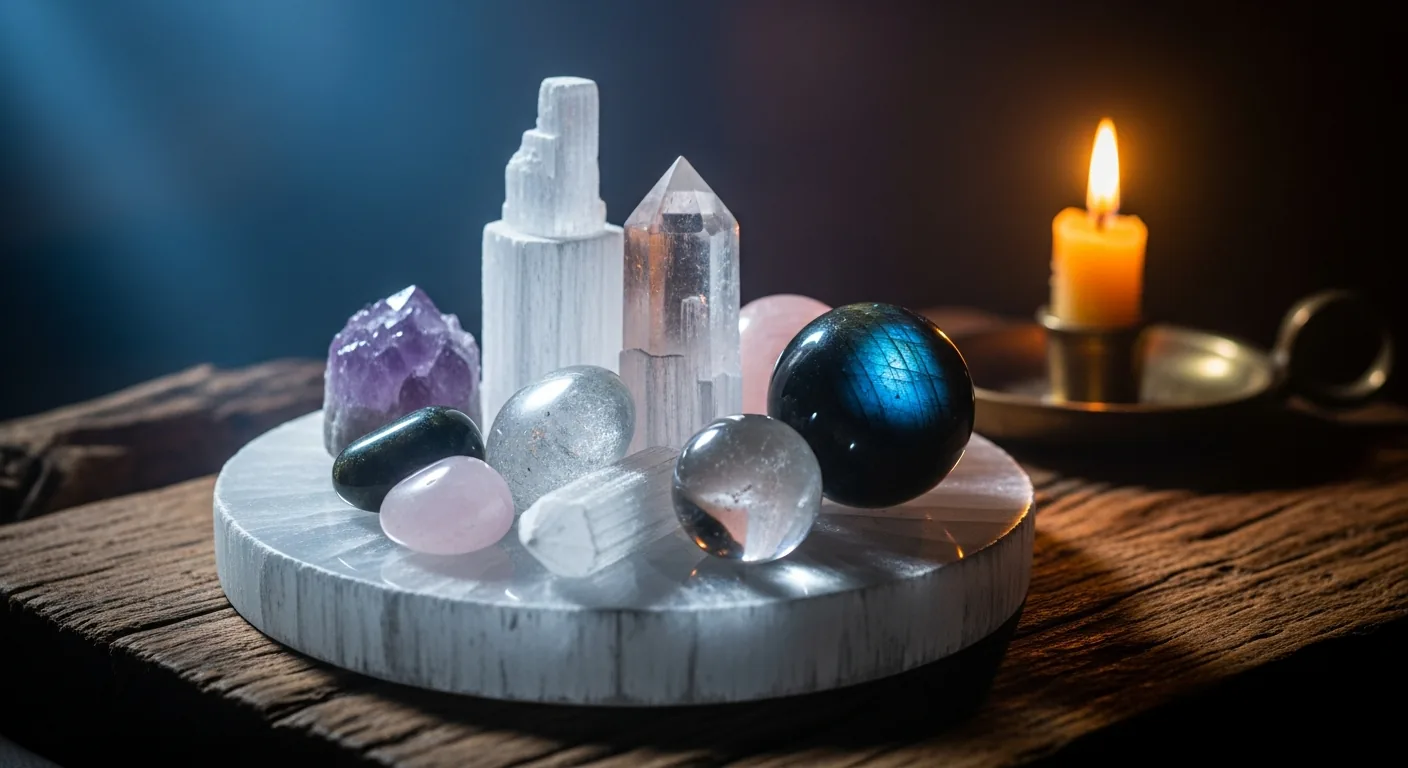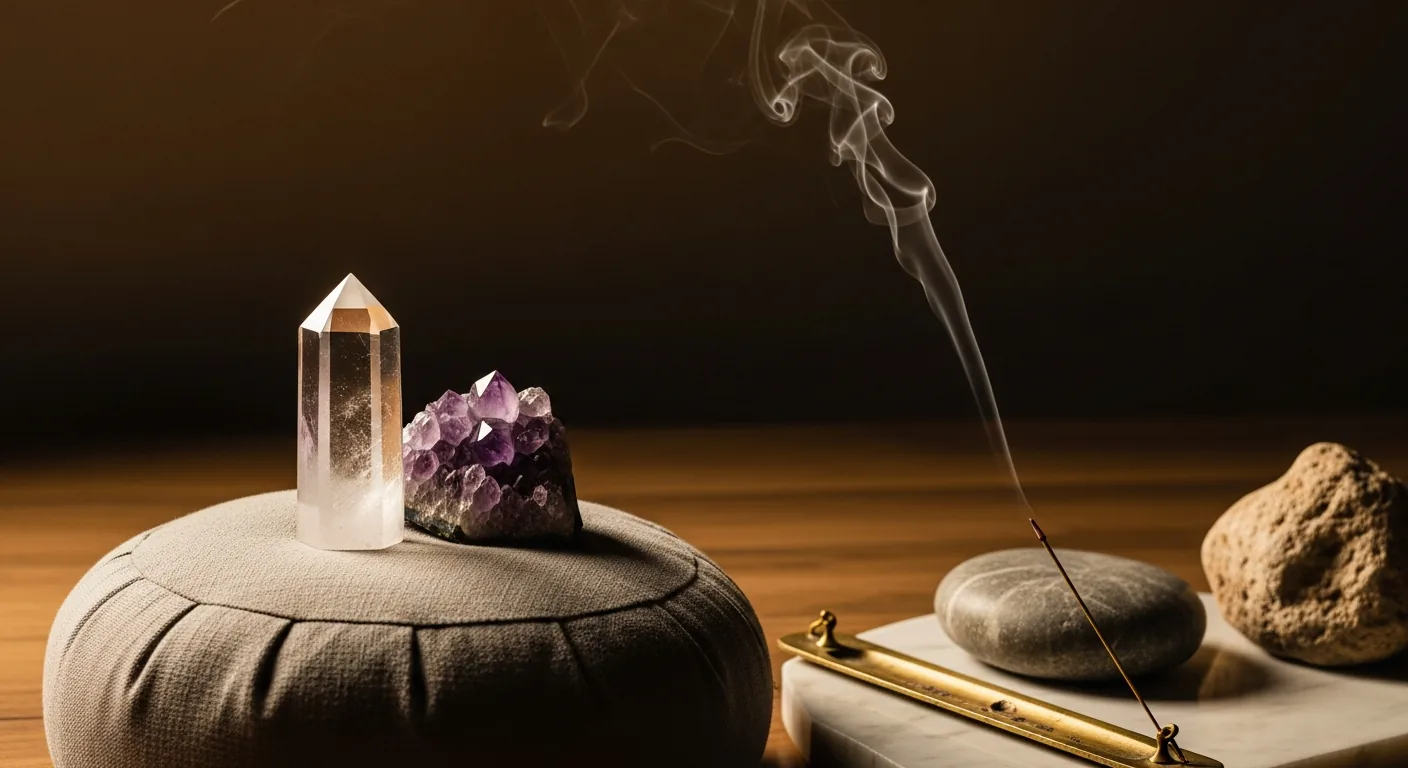
Meditation is already one of the most researched wellness practices in the world, with hundreds of studies linking it to reduced anxiety, improved focus, and better emotional regulation. Adding crystals to your practice does not change the meditation itself — it adds a tactile anchor, a focal point, and an energetic dimension that many practitioners find deepens their experience. This guide covers the best crystals for meditation, step-by-step techniques, hand positions, and chakra-specific practices.
Why Meditate with Crystals?
Crystals serve three practical functions in meditation: they act as a physical anchor that keeps your attention from drifting, they provide an intention-setting focus that gives your session a clear purpose, and they introduce a sensory element (weight, temperature, texture) that engages the body alongside the mind. Many practitioners report that holding a stone during meditation produces a noticeable difference in depth, focus, and duration compared to meditating without one.
The mechanism is straightforward. Meditation asks you to hold your attention on something — breath, a mantra, a visualisation. A crystal in your hand gives your body something concrete to hold while your mind settles. The cool weight of a stone warming in your palm creates a subtle feedback loop of awareness. You feel the stone, you return to the present moment, you deepen.
Whether or not you believe in the metaphysical properties of crystals, the physical sensation of holding one during meditation is useful in the same way a mala bead or a prayer stone is useful. It gives wandering attention somewhere to return.
7 Best Crystals for Meditation
1. Amethyst — Deep Stillness
Chakra: Third eye, crown Best for: Quieting mental chatter, deepening trance states, spiritual meditation
Amethyst is the most popular meditation crystal worldwide. Its violet frequency is associated with the third eye and crown chakras — the energy centres governing intuition, awareness, and connection to something larger than the self. Amethyst slows the mind without dulling it, creating a state of alert calm that is ideal for both beginners and experienced meditators.
Place amethyst on your third eye (between and slightly above your eyebrows) while lying down, or hold it in your left hand during seated meditation. Its energy is cooling and settling rather than stimulating.
2. Clear Quartz — Focused Intention
Chakra: All Best for: Intention-based meditation, amplifying other crystals, programming specific goals
Clear quartz is the most versatile meditation crystal. Because it amplifies whatever intention you set, it adapts to any type of meditation — healing, manifestation, gratitude, forgiveness, or simple presence. Its piezoelectric properties generate a measurable electrical charge under pressure, which some practitioners believe creates a subtle energetic feedback when held.
Hold a clear quartz point in your dominant hand during intention-setting meditations. Before beginning, state your intention clearly — either aloud or silently — and direct it into the crystal. The quartz becomes a container for that purpose throughout your session.
3. Labradorite — Inner Vision
Chakra: Third eye, throat Best for: Visualisation meditation, accessing intuition, dream work preparation
Labradorite enhances the visual dimension of meditation. Its labradorescence — the iridescent play of blue, green, gold, and violet light within the stone — mirrors the kind of inner imagery that arises during deep meditative states. Labradorite is particularly valuable for guided visualisation, past-life meditation, and any practice that involves inner seeing rather than inner stillness.
Gaze at the play of light within your labradorite before closing your eyes. Let the colours imprint on your inner vision. Then close your eyes and allow the meditation to unfold with enhanced visual clarity.
4. Selenite — Spiritual Connection
Chakra: Crown, third eye Best for: Crown chakra activation, spiritual meditation, energy clearing before sessions
Selenite is named after Selene, the Greek moon goddess, and its luminous, pearlescent quality evokes a sense of the ethereal. It is the best crystal for meditation practices focused on spiritual connection, higher guidance, and crown chakra activation. Selenite also clears the energy of a meditation space — passing a selenite wand through the air before sitting can noticeably shift the feel of a room.
Hold a selenite wand in both hands during seated meditation or place a flat piece on the crown of your head while lying down. Note that selenite is soft (Mohs 2) and water-soluble — handle it gently and keep it dry.
5. Fluorite — Mental Order
Chakra: Third eye, heart Best for: Focus meditation, mental clarity, studying before or after meditation
Fluorite is the most structured of the meditation crystals. Its cubic crystal system and orderly internal lattice are reflected in its energetic function: fluorite organises chaotic thinking. For meditators who struggle with scattered attention — jumping from thought to thought without settling — fluorite provides a stabilising influence that helps the mind find a single point of focus and hold it.
Hold fluorite in your non-dominant hand during seated meditation. If your mind wanders (and it will), gently squeeze the stone as a tactile cue to return to your breath or mantra.
6. Lapis Lazuli — Wisdom and Truth
Chakra: Third eye, throat Best for: Self-inquiry meditation, journaling meditation, accessing deep wisdom
Lapis lazuli has been revered as a stone of wisdom since the Sumerian civilization. Its deep blue colour, flecked with golden pyrite inclusions, has been ground into pigment for royal portraiture and sacred texts for over five thousand years. In meditation, lapis lazuli supports self-inquiry — the practice of asking yourself honest questions and sitting with whatever answers arise. It is the crystal for meditations that seek truth rather than tranquility.
Place lapis lazuli on your throat chakra during lying meditation, or hold it while journaling after a meditation session. Its energy supports honest self-expression and the courage to face difficult inner truths.
7. Moonstone — Emotional Depth
Chakra: Crown, sacral Best for: Emotional release meditation, lunar meditation, connecting with feminine energy
Moonstone brings emotional intelligence into meditation. While amethyst calms the mind and clear quartz sharpens intention, moonstone opens the emotional body. It is the best crystal for meditations focused on processing feelings, releasing grief, honouring transitions, or connecting with the cyclical nature of life. Its adularescent glow — a soft inner light that shifts as the stone moves — is mesmerising in candlelight, making it ideal for evening practice.
Hold moonstone over your sacral chakra (lower abdomen) during emotional release meditation, or simply cradle it in both hands during a full moon meditation practice.
The most powerful meditation crystal is one aligned with your birth chart. Find yours with our quiz — it takes just 2 minutes.
Step-by-Step Crystal Meditation Technique
This six-step method works for any crystal and any experience level. Practice it consistently for at least two weeks before modifying it.
Step 1: Prepare Your Space
Choose a quiet location where you will not be interrupted. Sit on a cushion, chair, or the floor — whatever allows your spine to be comfortably upright. Place your chosen crystal beside you. If you wish, clear the space by passing a selenite wand through the air or lighting natural incense.
Step 2: Cleanse and Connect with Your Crystal
Hold your crystal under cool running water for thirty seconds (skip this for selenite or other water-sensitive stones). Then hold it in both hands, close your eyes, and take three slow breaths. Feel the weight and temperature of the stone. Notice its texture. This sensory engagement begins to shift your awareness inward.
Step 3: Set Your Intention
With the crystal still in your hands, state your intention for the meditation — silently or aloud. Be specific. Rather than "I want peace," try "I release the tension I am carrying from today." Rather than "I want clarity," try "I open myself to understanding what is blocking my progress." The crystal becomes a vessel for this intention.
Step 4: Position the Crystal
Choose one of the hand positions described in the next section, or place the crystal on the relevant chakra point if you are lying down. Once the crystal is positioned, let your hands relax. The stone is set — you do not need to grip it tightly or focus on it constantly.
Step 5: Meditate
Begin your chosen meditation technique — breath awareness, body scan, mantra repetition, or visualisation. Let the crystal work in the background. When your attention drifts, notice the weight or warmth of the stone as a cue to return. Do not force anything. The crystal enhances what you are already doing.
Step 6: Close the Practice
When you are ready to finish, bring your awareness back to the crystal. Feel it in your hand or on your body. Take three deliberate breaths. Open your eyes slowly. Sit quietly for a moment before standing. Place the crystal on a selenite plate or in its resting place to clear the energy it absorbed during the session.
Hand Positions for Crystal Meditation
How you hold a crystal during meditation affects which energetic channels it engages. Here are the four most widely used positions.
- Receiving hand (left). Hold the crystal in your left palm, hand resting on your left knee, palm facing upward. The left side of the body is traditionally associated with receiving energy. Use this position when meditating with protective or calming stones — amethyst, moonstone, labradorite.
- Projecting hand (right). Hold the crystal in your right palm, hand on your right knee, palm facing upward. The right side is associated with directing energy outward. Use this position with intention-setting crystals — clear quartz, citrine — when you want to project a specific purpose.
- Both hands cupped. Hold the crystal in both hands cupped together at your navel or heart level. This creates a closed energetic circuit and is the most grounding position. Use it when you want full-body integration or when working with emotionally intense stones like lapis lazuli or moonstone.
- Point directed upward. If using a crystal point, hold it with the point directed toward your crown. This channels energy upward through the chakra system. Use it with clear quartz or amethyst during spiritual or crown-chakra meditations.
Chakra Meditation with Crystals
Chakra meditation involves placing a specific crystal on each energy centre while lying down. This practice balances the entire chakra system in a single session. You can work with all seven chakras at once or focus on one that needs attention.
| Chakra | Location | Crystal | Colour |
|---|---|---|---|
| Root | Base of spine | Red Jasper or Hematite | Red, black |
| Sacral | Below navel | Carnelian | Orange |
| Solar Plexus | Upper abdomen | Citrine or Tiger's Eye | Yellow, gold |
| Heart | Centre of chest | Rose Quartz or Green Aventurine | Pink, green |
| Throat | Throat | Sodalite or Blue Lace Agate | Blue |
| Third Eye | Between eyebrows | Amethyst or Labradorite | Purple, indigo |
| Crown | Top of head | Clear Quartz or Selenite | White, clear |
To perform a full chakra meditation, lie on your back on a comfortable surface. Place each crystal on its corresponding chakra point, starting from the root and working upward. Once all seven are placed, close your eyes and breathe slowly for fifteen to twenty minutes. Visualise each chakra as a spinning wheel of its respective colour, energised by the crystal resting on it. Remove the stones in reverse order — crown first, root last — when you finish.
Meditation Types and Crystal Pairings
| Meditation Type | Crystal | Duration | Focus |
|---|---|---|---|
| Breath awareness | Clear Quartz | 10-20 min | Present-moment attention |
| Body scan | Smoky Quartz | 15-25 min | Physical tension release |
| Loving-kindness | Rose Quartz | 10-15 min | Compassion and forgiveness |
| Visualisation | Labradorite | 15-20 min | Inner imagery and intuition |
| Mantra repetition | Amethyst | 20-30 min | Deep stillness and focus |
| Chakra balancing | Multiple (see above) | 15-20 min | Full-system energy alignment |
| Journaling/inquiry | Lapis Lazuli | 10-15 min | Self-honesty and insight |
| Emotional release | Moonstone | 10-20 min | Processing and letting go |
Tips for Beginners
Starting a crystal meditation practice does not require any prior meditation experience. Here are practical guidelines to avoid common mistakes.
- Start with one crystal. Amethyst or clear quartz is enough. Adding multiple crystals before you are comfortable with the basic practice creates distraction, not depth.
- Start with five minutes. A brief, consistent practice builds more than an ambitious one you abandon. Five minutes daily for a month will establish the habit. Increase duration gradually.
- Do not worry about doing it wrong. There is no wrong way to hold a crystal during meditation. If it feels right in your left hand, keep it there. If you prefer it on your lap, that works too. Trust your instinct over any prescribed method, including this one.
- Choose the same time each day. Morning meditation with crystals sets intention for the day. Evening practice releases the day's accumulated energy. Either works, but consistency matters more than timing.
- Cleanse your meditation crystals regularly. Stones used during meditation absorb whatever you release during the session. Place them on selenite after each use, or cleanse them with sound (a singing bowl or tuning fork) weekly.
- Keep a journal. Write briefly after each session — what crystal you used, what you noticed, any thoughts or images that arose. Patterns will emerge over weeks that help you understand which crystals work best for your specific needs.
Frequently Asked Questions
Can I meditate with more than one crystal at a time?
Yes, but keep it simple. Holding one crystal in each hand — for example, amethyst in the left (receiving) and clear quartz in the right (projecting) — creates a balanced energetic circuit. During chakra meditation, you may place up to seven crystals on your body simultaneously. For seated meditation, one or two crystals is usually sufficient. More is not necessarily better; clarity of intention matters more than the number of stones.
How long should a crystal meditation session last?
Beginners should start with five to ten minutes and increase gradually over several weeks. Experienced meditators typically find that fifteen to twenty-five minutes with a crystal produces the deepest results. Chakra meditation with multiple stones works well at fifteen to twenty minutes. There is no upper limit, but sessions longer than forty-five minutes rarely add benefit and can leave you feeling ungrounded. Quality of attention matters more than duration.
What should I do if I feel strong emotions during crystal meditation?
Strong emotions during meditation — tears, anger, unexpected memories — are normal and often indicate that the crystal is working with a blocked energy centre. Do not resist the emotion. Breathe slowly and allow it to move through you. If the intensity feels overwhelming, gently remove the crystal from your body, open your eyes, and place both feet flat on the floor. Ground yourself with a few deep breaths before deciding whether to continue. These experiences are usually cathartic and pass within minutes.
Do I need to believe in crystal energy for meditation to work?
No. Even from a purely practical perspective, holding a crystal during meditation provides a tactile anchor that improves focus. The weight, temperature, and texture of a stone in your hand give your sensory awareness something concrete to return to when your mind wanders. Many sceptics who try crystal meditation report improved session quality simply from the physical grounding effect, regardless of their beliefs about metaphysical properties.